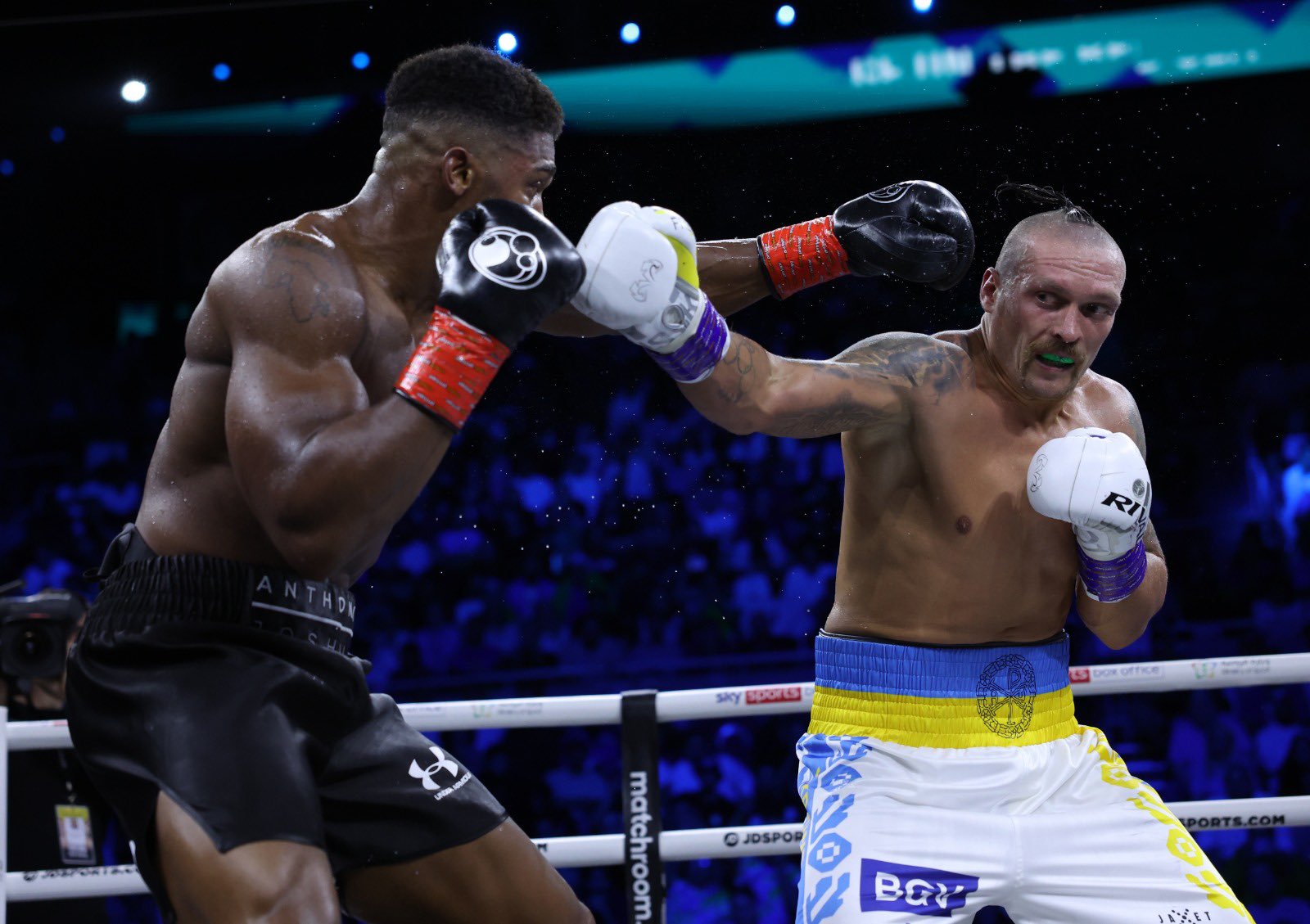
An Open Letter To Anthony Joshua
By Steve Hunt
Dear AJ,
I hope you don’t mind me calling you AJ. Obviously, we have never met, but I have followed your career closely over the last ten years since your gold medal success at the 2012 Olympics.
I was sorry to see you lose the rematch with Usyk. He’s pretty good, isn’t he? I know you regret what you said in the ring after the fight, but I understand it must have been really hard to accept that defeat and in the heat of the moment we have all done things we later regret.
In the week leading up to that fight, I had been watching some Ron Lyle fights. I don’t know how familiar you are with Lyle. Although he was never a world champion, he was part of that golden age of heavyweights in the 1970s. Flick through the pages of a mid-70s Ring magazine and he’ll be somewhere around the middle of the top ten heavyweight rankings. In the aftermath of your loss to Usyk in Saudi, I couldn’t help thinking about Ron, as well as the situation that you find yourself in.
Lyle was also a late starter in the game, much later than yourself in fact. He was convicted of second-degree murder in 1962 for a gang-related killing when he was twenty-one years old. His sentence was fifteen to twenty-five years imprisonment. While in the penitentiary, Ron was involved in an altercation with another inmate and was stabbed in the abdomen. He needed thirty-five pints of blood from transfusions. It was thought that he would not survive. His death certificate was already signed, and he was pronounced clinically dead twice before staging a comeback greater than any he later achieved in a boxing ring.
One night while he was still in his hospital bed, Ron had a dream that he took to be a vision or a message of the route that he should take with his life. In the dream, he was fighting for the heavyweight championship of the world. The dream was so vivid and impactful, that it proved to be a turning point in Ron’s life. Lyle had always been a very capable athlete, but he had never previously considered boxing as a possible path. From now on, he pursued it relentlessly.
When he was well enough to leave the hospital and return to prison, he was immediately placed in solitary confinement due to his alleged role in the fight that had nearly killed him. Lyle had forged a close and trusting relationship with one prison officer, who had encouraged his athletic endeavours. He told Ron that the fitness needed to be a fighter was another level from anything he had done so far, so Ron put his time in solitary to good use.
With limited space, Lyle concentrated on running on the spot, sit-ups, and press-ups, reaching the point of being able to do one thousand press-ups in an hour.
Once he was out of solitary confinement, Ron started boxing in the prison, although with obviously limited opportunities. He was initially declined parole. His planned career as a boxer did not satisfy the board. Persistence paid off and after further hearings, they were convinced. Lyle was released after having served seven and a half years in prison. It was November 1969 and Ron was 28 years old with an ambition to be the heavyweight champion of the world.
So, AJ, why I am I telling you this part of the Ron Lyle story? Well, your brushes with the law as a young man have been widely reported. In fact, you referenced them yourself in that emotional speech in the ring post-Usyk. Using boxing to turn away from a life of crime is another thing you have in common with Ron. He spent most of the 1960s behind bars, not knowing when he would get out. But once he had his goal, he kept his focus. You know what that is like. Not everyone can do that.
Time was not on Ron’s side, so after a two-year amateur career, consisting of twenty-two fights, the Denver heavyweight turned professional in 1971.
This was a time when Ali was returning from exile, Joe Frazier was world champion and George Foreman was rising through the ranks after winning gold at the ’68 Olympics. The heavyweight rankings were shark-infested waters.
At the start of 1975, Lyle was close to the top of the heavyweight rankings. He had compiled a record of 29-1-1, with wins over the likes of Oscar Bonavena, Jimmy Ellis, and Jurgen Blin. His solitary defeat was a points loss to Jerry Quarry. No disgrace there. A title shot against Ali felt close. But then what seemed like disaster struck, when Ron suffered his second points loss, this time against Jimmy Young in February 1975.
The headline on the front cover of the Ring magazine read, How to Lose a Million in One Night! The Ali fight seemed gone. Coming to terms with defeat must be hard, especially when achieving your goal seems so close. Unfortunately, AJ, you know this as well as anyone. Only the heartless could not have felt for you as you shed tears in that post-fight press conference in Saudi.
Ron Lyle could have told you what it takes to deal with these setbacks. As he said at the time, “One loss doesn’t end a career, and it won’t kill mine. I came back from the Quarry setback, and I have time and all the desire in the world to do it again. I know the loss hurts my chances, but only one other fighter in the top ten has as few as one loss. Even Ali and Frazier have lost twice”.
He felt then what you are going through now.
Incredibly, the fight against Ali for the world heavyweight title still came off next for Lyle. He must be one of a very small number of challengers to come into a title fight on the back of a loss.
The fight was set for Las Vegas in May 1975. Ron had gone from a prison cell to a world heavyweight title challenge in six years while overcoming obstacles on the way. From boxing novice to sharing a ring with The Greatest. He was living the dream that he had in that hospital bed a few years beforehand. But there was no fairy tale ending on this occasion. Ahead on the scorecards after ten rounds, Ron was stopped in the eleventh. It was a strange performance from Ali. Prior to the fight, he had claimed that he would force Lyle into the rope-a-dope, wear him out and stop him in eight. Lyle would not fall into that trap and pulled away on the scorecards. Ali had to change tactics later in the fight and as the great ones do, found the shots to secure the win.
Lyle now found himself with back-to-back defeats. Much as you do now, AJ. What he couldn’t have known, was that he was in the middle of a stretch of fights over the course of a year that must rank with the hardest succession of heavyweight matches ever undertaken.
What do many fighters do today after a loss? Take several months out? Change trainers? Come back with an easy win? Not Ron. His next two fights were against Earnie Shavers four months later and then George Foreman in January ’76. People often talk about the Foreman fight as being one of the greatest slugfests of all time, but the Shavers fight is not far behind it.
So, in one year Ron Lyle fought Jimmy Young, Muhammad Ali, Earnie Shavers, and George Foreman. Just pause there and have a think about that.
AJ, while you are pondering your next career move, it is worth reflecting on the career of Ron Lyle. He lost three of those four fights in that incredible year; two of them by stoppage. He never achieved his ultimate ambition of becoming heavyweight champion of the world. Depending on how you look at it he either had the good or bad fortune to be competing in possibly the toughest of all heavyweight eras.
But how do boxing fans who know their history consider Ron Lyle now? He is a legend. Look at his story and what he made of himself from extremely humble beginnings. What could he have achieved if he had been nurtured in a gym from a young age? He maximised his potential as a boxer, took the toughest fights available to him, won some, and lost some. To most fans, the outcome of those fights is almost irrelevant. You can be remembered for who you fight, but also for who you don’t fight.
The Ron Lyle story is over. He was not an all-time great, but he will always be remembered and respected. Fans will always enjoy watching his old fights. AJ, your story has yet to run its full course. You have already given us many highlights, but I can’t wait to find out how this one ends. If he were in your shoes right now, what would Ron do?
Photo Credit: Mark Robinson/Matchroom Boxing


Awesome
LikeLike
Excellent inspiring stuff which is sadly lacking today.Hope AJ can get the message from this and inspire others by taking the hard path of a man with some character.Boxing looks like a cynical money making game ,boxers appear to be the pawns of big money making players.I hope he shows character and it shines through to inspire young men not to give up.
LikeLike
This is so inspirational,I hope AJ will ruminate over this and put up a great flight in his next fight.Thumbs up to Steve hunt.
LikeLike