Beyond The Ropes: Preya Dhanecha
I am probably on a bit of a crusade. Within the often-neglected world of women’s boxing, I am on a mission to tell as many stories as I can. Sometimes, you just stumble on a little gem of a tale. The story of Preya Dhanecha is one such story.
The 43-year-old grew up in Peterborough in a time of abject racism. A far less tolerant world, sadly a time we are seemingly heading back into. Creating division for political gain is once again regrettably rife. But for someone who was born in 1981, Dhanecha is brutally aware of that often bigoted time.
“I am the first generation child of Ugandan Asian refugee parents,” Dhanecha told me. “My early childhood was spent on a lovely little council estate in Peterborough. I’m an 80’s child, so there was definitely a racist undercurrent where I grew up, but the estate I grew up on was a really sweet little community. I remember my best friend next door. We used to climb over each others’ garden fences to play together. A lady four doors down used to braid my hair when we had events. My aunty lived a few doors down with my three cousins. There was an elderly couple next door to us who were like beloved surrogate grandparents to me and my brothers. It was all quite idyllic (or maybe I’m looking at this through rose-tinted shades), but I remember my young childhood being quite happy. There was a lot of running around outside on the field near our house, sledging down snowy hills, and being on a first-name basis with the ice cream man.
“When I went to secondary school, we moved out of the area, and it was here that things changed. I was in a secondary school where there was only a handful of people of colour out of around 2000 children (my brother and cousin making up part of that handful) and as I went into my pre-teen years, the difference between me and the other children became more apparent. Trying to correctly navigate the Western world with my African-Indian upbringing was difficult. Those two cultures, especially as first generation and female and the youngest of two older brothers, could not be more opposing.”
In many ways, Dhanecha has always been around sports, albeit the initial entry was mainly just for enjoyment purposes and for a place of acceptance.
“I always loved sports day at school and being out on my bike with my brother, I think I even represented my school once in swimming. But for the most part, I just had fun with it. I only really became serious about sports when I became a teenager. Being the ‘odd one out’ at school and not ever fully being able to integrate with the other girls (I was never cool or pretty enough for that), I just looked for somewhere I felt accepted and could find a sense of belonging. Fitness and sports gave me that, and by the time I was in my GCSE years, I’d managed to carve out my own identity at school as “the fitness freak.”
Dhanecha came from a time when many things were not accepted. Women’s boxing wasn’t exactly in a place where it is now. Who could ever forget what Jane Couch had to put herself through just for the right to fight? Preya Dhanecha has some semblance of that kind of story.
“I watched boxing from when I was really young with my eldest brother,” Dhanecha relayed to FightPost. “We have always been super close, and back then, I watched it just so I could stay up late and hang out with my brother. I developed a love for the sport as I got a little older, and by the time I was a teenager, I was completely obsessed. There was no way my parents were ever going to let their youngest daughter box, especially when they said no to the eldest son.
“I did kickboxing for a while, which was fun, but as soon as I got the feel of a proper glove on my hand, I knew that I wanted to box. But that opportunity wouldn’t come for another ten years. When I was at university (studying Sports Science), it was in my Master’s year at Brunel that I decided I’d try to join a boxing club, I called around a few local clubs but was told that I couldn’t join because I was female. My friends and I decided we’d start up an affiliated club within the university, and being the Chair of the club at the time, who could tell me no?
“So we set the club up, but the work it took to get it off the ground and then have the coach agree to train me to compete took a while. I ended up having my first contest at the age of 25, ironically, after I’d graduated and left Uni.
“I knew my mum and dad did not want me to box – Safety reasons, but also, culturally, it just wasn’t the done thing. I didn’t have the guts to tell them that not only had I been boxing a year, but also, that I’d just won my first national title. So I emailed them.”
Dhanecha has a unique take on what the attraction of boxing is to her.
“I grew up with some very strong characters. My mum and my two brothers especially. My dad is a quiet guy, but again, having come over from Uganda in the 70’s that generation always had an inner steel about them. Essentially, I wanted to be strong. I didn’t want to just “act” strong like a lot of the kids at school, I wanted to somehow be validated as a strong person. I guess I equated boxing with being strong because it’s not just physical strength and fitness. You have to be mentally and emotionally very strong, too. I was also attracted to the aesthetic of boxing (my Masters dissertation was on this). For me, there was something really cool about the movement of a boxer – I guess it was parallel to what attracted me to take up dance lessons at various points in my life.”
“Oh God! Everything I need to feel powerful, capable, and accomplished.” Dhanecha says of what boxing gives her.
Dhanecha had twenty fights in her boxing career. But she can still recall that very first ring walk.
“Yes, I can remember it very well, and it felt awful,” Dhanecha says of that first fight. “I can laugh about it now, but I remember placing so much pressure on myself to win it. I basically crumbled, and though I put up a reasonable fight, my opponent won, and convincingly. The one thing that stayed with me, though, was when I got out of the ring, one of the judges told me I had potential and not to give up. Which I didn’t. And I’m so glad I stuck with it.
“I had just over twenty fights. Which doesn’t sound like many at all compared to today’s standards. But, the pool of under 48kg (light flyweight), female boxers was tiny. It took me seven years to build that up.”
The resume, despite only having a limited number of contests, is still nonetheless impressive. “I am a two-time ABA Champion, Haringey Box Cup Champion, and a two-time British University Champion.”
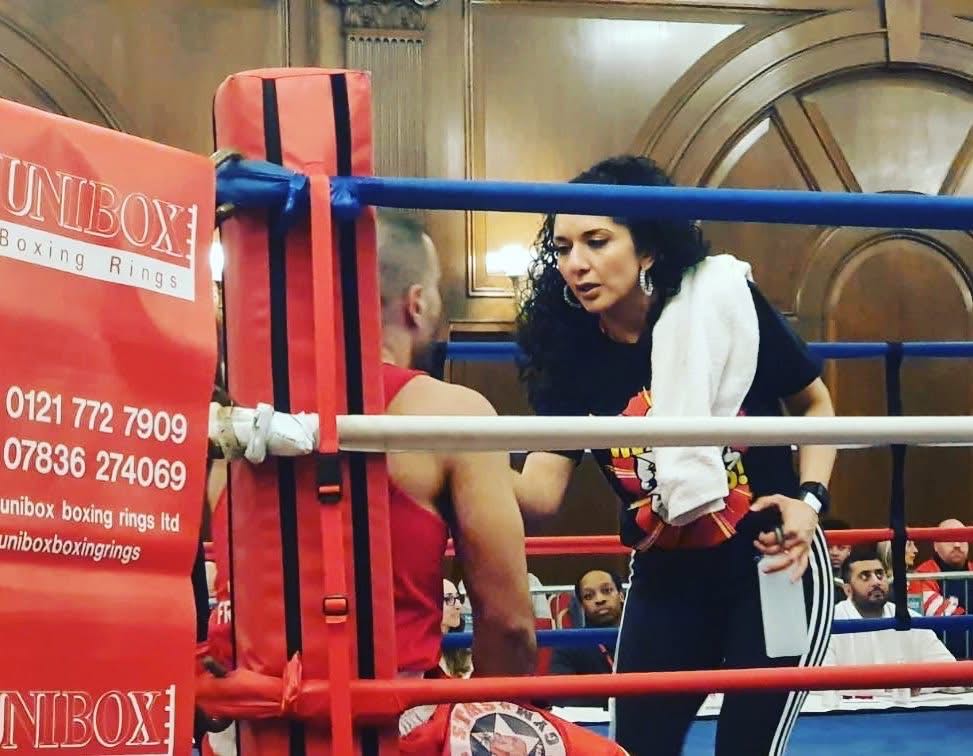
But Dhanecha is now on another path within her chosen craft. “In 2023, I passed my assessment to be an England coach and my year’s trial to become a development coach for Team GB. In that year, I also completed my senior coaching qualification with England and coaching in High-Performance Sports with GB.”
“It’s so hard to pinpoint this. But winning my first ABA title was definitely one of them,” Dhanecha says of what her proudest moment in the sport is. “It wasn’t the title itself, but it was something tangible that made me feel like I might be half decent. It made a dent in the self-doubt I experienced. Having said that, passing my England and GB assessments as a coach has been unreal. The ultimate validation is accepted by the national team. I’ve never felt more proud and still have to pinch myself. I just want to continue coaching and developing my abilities at England and GB level.”
But her varied life and career took another little turn a few years ago.
“Funnily enough, back in 2023, I was asked to be the co-commentator for the NAC finals which were held in Newcastle and live-streamed on the BBC,” Dhanecha told me. “I’d never been on the mic before, but it opened up a few doors for me with Wasserman and Chanel 5 (thanks to Dave Farrar, who has really supported me). I will continue developing as a coach for as long as I’m physically able to do it, but my other long-term aspiration is definitely to develop and work as a commentator! Being able to do the Olympics is the ultimate dream.”
Boxing has undoubtedly been an integral part of her life. A sense of belonging and much more. Boxing does that. For Dhanecha, it probably defines her.
“It’s able to have an unwavering belief in yourself, even in the face of setbacks. Sport, especially high-performance sports, will push you to your limits in every way. I remember feeling this pressure during my year’s trial with Team GB and my partner’s (comforting) words to me were, “Welcome to high-performance sports!” And it’s true, it’s meant to push you to the point you doubt yourself. I’ve learnt over the years to be ok with that feeling and just to keep going anyway.”
Outside of boxing, the life of Preya Dhanecha is very different. “I work in Child Safeguarding at a lovely school in West London. I’ve worked in education for my entire adult life.
“I love to learn, so I’m currently learning to speak Spanish. Getting the school holidays means I have the opportunity to go away a lot. I love going to different countries. I also love a challenge, so this summer I’m going on a trek up some mountains in Slovakia for a few days.”
“Honestly, I felt like the real-life Jess from the movie, Bend it Like Beckham, which for me, is still one of my favourite films of all time.”

 FightPost: Boxing & MMA News