There Will Be Blood: Christy Martin’s Fighting for Survival: My Journey Through Boxing Fame, Abuse, Murder and Resurrection
By Andrew Rihn
Pain and suffering are a kind of currency passed from hand to hand until they reach someone who receives them but does not pass them on. Simone Well
“In boxing, it’s you who’s at risk,“ writes Christy Martin. “And you’re the one who has to take the action necessary to save it because you’re worth it.”
Christy Martin knows what she’s talking about. A trailblazer for women’s boxing, Martin helped to legitimize women’s participation in the sport. She was the first female boxer to achieve international acclaim and the first woman promoted by Don King. She fought on Mike Tyson undercards in the 1990s and won some of the sport’s first female world titles. In 2020, she was the first woman elected to the International Boxing Hall of Fame.
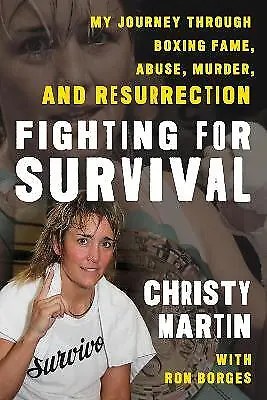
Her autobiography, Fighting for Survival: My Journey Through Boxing Fame, Abuse, Murder and Resurrection is a heart-rending look at a life spent taking those risks, both in the ring and out. For Christy, some of these risks paid off in a big way. But others nearly killed her.
Martin grew up in what outsiders disparagingly refer to as backwater West Virginia. Born Christy Salters, she grew up in a small coal town called Mullens. “A town without a traffic light,” she writes. Christy’s father worked down the mines. When she became a prominent boxer, Christy became known as the Coal Miner’s Daughter.
But professional boxing was not an easy sport for women, especially when Christy began in the late 1980s. Martin’s initiation into boxing took place in something akin to a county fair environment, where boxing was something of a sideshow sport, a space where entertainment is at least as important as athleticism. Playing college basketball during the week, the young Christy began entering local Toughman competitions on the weekends, unsanctioned bouts that took place in a “kind of regional boxing tournament for guys who had never boxed but thought they were tough.”
Christy looks back on those early, difficult days with a bemused appreciation for her own struggles. Toughman was where Mr. T got his start, Christy mentions, and so did Eric Esch, the boxer better known as Butterbean, the 400-pound super-heavyweight and “King of the Four Rounders.” Mr T went on to appear in Rocky III and The A-Team. Esch appeared in 2002’s Jackass: The Movie where he “fought” Johnny Knoxville inside a department store. “What Mr T and Butterbean achieved,” writes Christy Martin, “are the possibilities that exist only in a crazy place like boxing.”
Christy Martin’s own big break came in 1993. She and her husband-slash-trainer, Jim Martin, had secured a meeting with Don King, the most powerful boxing promoter of the 80s and 90s. As she tells it, their car needed work and they pulled into King’s office with the engine smoking. Things didn’t go any more smoothly inside the offices. Jim had brought along a VHS tape of Christy’s fights but King’s office did not have a VHS player. Christy shadow-boxed for King right there in his office. Despite every obstacle, Christy impressed the vertiginously-haired promoter enough that he signed her on the spot.
Although she had been boxing for four years, Christy was now being promoted by Don King, and she made more money in one fight than she had for her entire career up to that point. She began fighting in Las Vegas on the undercards of Mike Tyson bouts. That meant her fights were being televised, too. On one such pay-per-view event in 1996, Christy faced off against Irish fighter Diedre Gogarty (who had moved to the US because women’s boxing was banned in Ireland). Tommy Morrison, the heavyweight contender featured in Rocky V, was on hand to provide color commentary. Despite being low on the undercard, the two women delivered an aggressive and charismatic display of courage that fans did not expect. Gogarty was dropped in the second but got herself up and socked Christy in the face, breaking her nose. Blood spurted from the break, running down Christy’s pink trunks, smearing onto Gogarty, the referee, and the canvas. Her team tried to stop the flow of blood between rounds, but the cut stubbornly re-opened with each round. Martin and Gogarty persevered, slugging through the gore. The crowd loved it. The two fighters showed grit that many thought was incapable for female boxers. In newspapers around the country, it was declared the most memorable bout of the night.
After that blood-soaked performance, Christy was a star. Time magazine was calling. So were the late-night talk shows. Within a few weeks, Martin became the first female boxer to grace the cover of Sports Illustrated. Headline: “The Lady Is A Champ.” She even appeared on an episode of Roseanne. “One sportswriter said it was the most valuable nosebleed in history,” she recalls.
But Christy’s autobiography is much more than her rags-to-riches boxing story.
Christy Martin is gay, a fact she kept hidden from public view while she was fighting. Growing up in 1980s small-town West Virginia had been difficult, and Christy struggled with this aspect of her identity. She had also survived an intimate childhood trauma at the hands of an older cousin, and trauma has a way of clouding all aspects of a person’s life, at unexpected times and in unexpected ways. Her husband and trainer, Jim Martin, knew Christy’s secret, and he used this secret to leverage her. Outing her as gay at that time would have been disastrous to her career.
In the ring, Christy’s persona of the Coal Miner’s Daughter had been crafted to avoid certain misogynistic and homophobic stereotypes attached to female athletes in the 90s (stereotypes that persist to this day). Christy Martin played the good wife in interviews and wore pink trunks when she fought. At the same time, Christy was the most famous female boxer in the world, she was also a closeted gay woman trapped in a loveless, abusive marriage, thrust suddenly into the scrutiny of public view.
In writing about her own life, Christy necessarily writes about the impact Jim Martin had on her. Jim was a controlling and misogynistic man, insecure of himself and resentful not only of Christy’s success but of his own dependence on that success. He isolated Christy, twisting her world so that she viewed herself as dependent upon him, even though it was her prizefighting that paid the couple’s bills. Like most abusers, Jim became more and more controlling as the years wore on, grinding down her self-esteem. The abuse took its toll and eventually, Christy turned to drugs. Or rather, Jim steered her to them, nurturing and exploiting her chemical dependency.
Things turned from bad to worse. In 2010 Jim Martin, an abuser escalating his behaviour, attacked Christy Martin with a buck knife, stabbing her multiple times in the chest, puncturing a lung and cutting her left calf clear to the bone. Then, using Christy’s own pink 9mm handgun, he shot her in the chest and left her for dead on the floor of their Florida home.
But Christy was hard to kill. She was determined to survive, determined to live. Jim lacerated his hand in the attack and went to take a shower. That was the moment Christy gathered an almost superhuman willpower and strength. She lifted herself off the concrete floor, the 9mm slug still lodged just three inches from her heart. She stood up, willed herself outside, and flagged down an oncoming car.
Christy survived her would-be murder. But survival wasn’t enough. She had been merely surviving for years while being abused. “Surviving is not living, but it’s not dying either,” she explains. “It’s holding on until you can find a way to start living again.” Christy wanted more from this resurrection. She got sober. She got back to the gym, back to training. She even got back into the ring, though her biggest fights were past her.
Her last professional fight was in 2012, a rematch against former opponent Mia St. John, whom Christy had beaten a decade earlier. She lost the fight and ended her storied career at 49 wins, 7 losses, and 3 ties. But numbers alone provide pale evidence of a fighter’s relentless spirit and sometimes pigheaded vitality. They can only ever hint at the adversity she faced and the rugged joy she claimed in victory.
“You don’t find too many well-adjusted prizefighters,” writes Christy Martin. “We all have our demons, something driving us to run toward pain when human nature says run away.” True to form, Fighting for Survival is a book that isn’t afraid to run towards the pain. Christy doesn’t sugarcoat much. She is open about her contradictions, her struggles, and even her failings. But there’s a quote Christy Martin returns to in her book. The early boxing pioneer “Gentleman” Jim Corbett said simply, “You become a champion by fighting one more round.”
Christy Martin is now the CEO of her own promotion company, making sure her fighters are protected and looked out for in ways she never was. She also travels the country connecting with survivors of abuse, healing herself through healing others. Jim will spend the rest of his rotten life in jail.
Stubborn as anthracite, and just as good under pressure, Christy Martin’s Fighting for Survival shows us just what going one more round looks like. This is her life now, finally. She’s fought for it. She’s bled for it. And she deserves every blessed second of this happy life.

 FightPost: Boxing & MMA News